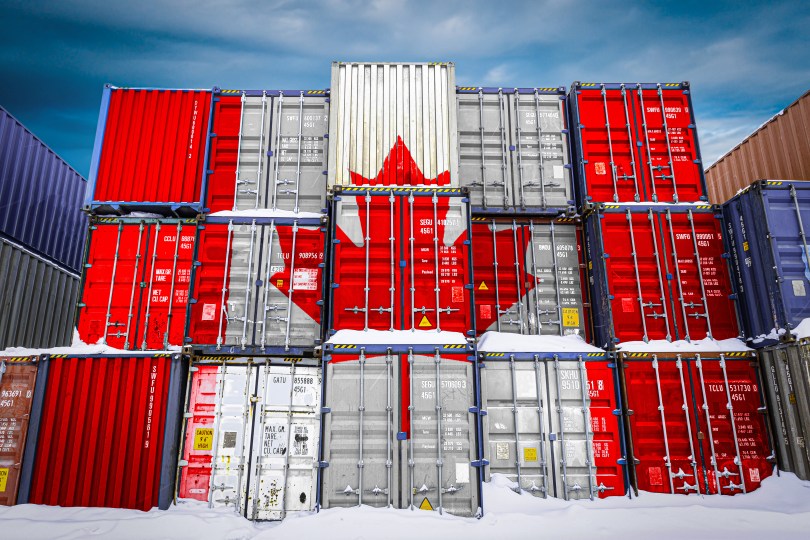
Muddling Through or Zombie CUSMA: Five economic scenarios for uncertain times

By Christopher Cotton
Jarislowsky-Deutsch Chair in Economic & Financial Policy, Queen’s University
Director of the John Deutsch Institute for the Study of Economic Policy

Last week, I had the pleasure of presenting on the future of the Canadian economy during the 38th Annual Forecast Lunch hosted by the Smith School of Business and the Kingston Economic Development Corporation. This article is Part 2 in a 2-part series summarizing my presentation. Part 1 of this series shows that Canada is facing declining incomes stemming from structural issues beyond current trade woes.

Providing an economic forecast for the next year is an impossible task. At least, it is impossible to do with any degree of legitimate confidence. While some forecasters may get lucky with their guesstimates and claim their accuracy is an indication of brilliance, the reality is that no one knows for sure what the next year holds. The margin of error for 2026 is wider than it has been in decades.

The outlook for 2026 is clouded by three distinct sources of deep structural uncertainty:

Read More »

Canadians are getting poorer: The economic crisis runs deeper than trade woes

By Christopher Cotton
Jarislowsky-Deutsch Chair in Economic & Financial Policy, Queen’s University
Director of the John Deutsch Institute for the Study of Economic Policy

Last week, I had the pleasure of presenting on the future of the Canadian economy during the 38th Annual Forecast Lunch put on by the Smith School of Business and the Kingston Economic Development Corporation. This article is Part 1 in a 2-part series summarizing my presentation. Part 2 presents five economic scenarios for uncertain times.

On the surface, the Canadian economy appears to be finding its footing. Headline inflation has largely returned to target, interest rates have moderated from their 2024 peaks, and Canada continues to report relatively high GDP growth compared to many of our G7 and OECD peers.

But these positive trends mask deep structural concerns about a country that is struggling to attract investment, retain talent, and improve its standard of living. Layered on top of these domestic challenges is an unprecedented level of economic, political, and international uncertainty, making sustainable growth elusive.

Read More »

Crises Push Kids Into Classrooms, But Not Into Learning

By Christopher S. Cotton & Ardyn Nordstrom

Over recent decades, global education has made significant strides. More children than ever are attending school. But how resilient are these gains during economic downturns or environmental crises?

Our recent study explored how a severe drought in rural Zimbabwe impacted education outcomes. We found that the agricultural and economic shock increased school attendance and progression, standard measures that are typically correlated with increased learning. From these results alone, we may have concluded that droughts encourage kids to attend more school, thereby increasing their education outcomes.

However, we had access to a detailed data set on test scores from the region, the analysis of which told a different story. Even as children attended school at higher rates, their performance and learning progress decreased. Crises drove kids to school, but did not increase learning.

Our findings highlight a broader challenge: the correlation between more schooling and more learning can break down during crises. Higher attendance and enrollment rates alone should not be viewed as indicators that children have better education outcomes during such times. Studies that rely on the quantity of education to assess impact may come to the wrong conclusions. This disconnect calls for rethinking how we measure education success during challenging times.

Read More »

Can Paying Peer Reviewers Fix the Referee Shortage in Medical Research?

By Christopher Cotton, Abid Alam, and David Maslove, Queen’s University

Peer review is central to scientific publishing. Whether in economics, science, or medicine, peer review ensures research is carefully checked before reaching practitioners, policymakers, and the public. Yet, the system, which relies on experts volunteering their time, often struggles to secure enough qualified reviewers. As submissions increase and experts’ time becomes increasingly stretched, journals face delays, rushed or lower-quality reviews, and inconsistencies in evaluation.

Medicine experienced heightened challenges during the COVID-19 pandemic, as high submission volumes and limited expert availability put unprecedented strain on the system. Many researchers turned to pre-prints (papers published online without formal peer review) to speed dissemination, a practice historically less common in medical publishing.

Could paying peer reviewers help alleviate the reviewer shortage? We tested this question experimentally at Critical Care Medicine, a leading medical journal (see also the coverage of our work at Nature). Our study found modest improvements, suggesting that payment alone is insufficient to fully address the peer-review bottleneck.

Read More »

Interprovincial Trade Barriers: What are they? How costly are they for Canada? And How Can We Address Them?

By Daniel Teeter and Christopher Cotton, Queen’s Economics Department

While Canada champions free trade on the international stage, its internal market remains fragmented by a web of provincial regulations, a lack of infrastructure, and other barriers to businesses operating across provincial borders. Our recent JDI Policy Insight article, “Breaking Down Canada’s Internal Trade Barriers,” considers the impediments to within-Canada trade, the costs of these barriers, and summarizes 22 potential reforms and investments that may help alleviate the barriers.

The Cost of Division

The paper underscores a startling reality: interprovincial trade barriers are potentially as costly as a 7% tariff on goods crossing provincial lines, inflating consumer prices by an estimated 7.8% to 14.5%. This artificial inflation stifles competition, hampers innovation, and curtails economic growth. The authors estimate that dismantling these barriers could boost Canada’s GDP by up to $161 billion annually, or an additional $2,300 to $4,000 per Canadian per year. Yet, despite these potential gains, such barriers persist.

Read More »

True North Strong (But Free?): Frictions to Inter-Provincial Trade in Canada

This QED Spotlight article by Brock Mutic (JDI Research Associate) presents research by QED Professor Beverly Lapham and PhD Candidate Daniel Teeter.

It is widely agreed upon by economists that intra-national trade frictions—barriers to seamless trade between regions within a country—can impact a country’s economic performance. In the Canadian context, as each province and territory has its own regulatory environment and particular trade rules, provincial borders—in addition to being geographic—are also frictional and affect the flow of goods and services within the country. Understanding the size of inter-provincial trade frictions in reality, and their effect on the flow of trade in Canada, is an important question for understanding their costs to the Canadian economy. Queen’s Economics Department Professor Beverly Lapham recently teamed up with QED Ph.D. candidate Daniel Teeter to study this important issue in a recent QED Working Paper, where the team used a state-of-the-art gravity analysis to examine the size and importance of inter-provincial trade frictions in Canada between 1997 and 2019. Their research ultimately produced insightful and policy-relevant results. 

Read More »

Why Housing Markets and Home Affordability Vary Across Cities

QED Research Spotlight by JDI Research Associate Brock Mutic summarizes recent research by QED Professors Allen Head and Huw Lloyd-Ellis in collaboration with former PhD student Derek Stacey

Deciding whether to buy or rent a home is one of the largest financial decisions many people make. Across cities in the United States, however, this decision is not made equally, as the affordability of homeownership varies; in different cities, it is relatively more or less affordable to buy a home, compared with renting. Although economists hypothesize these differences are driven by local economic conditions, understanding which local factors are at play is no easy task: the effects in question lay submerged in the depths of the economic ocean, driven by the rough currents of the dynamic and complex housing market, and are not easily visible from the surface. Wading through the tide, and pulling the relevant effects up from below, is a task requiring a very precise net, and a very steady hand. 

Recognizing that the determinants of home affordability are relevant for millions of people however, as everyone needs a home, Queen’s Economics Department researchers Dr. Allen Head and Dr. Huw Lloyd-Ellis, in collaboration with Dr. Derek Stacey of the University of Waterloo, were undeterred by the waves. Setting their boat on the water, they engaged in research to study the question, in a paper recently published in International Economic Review. The team built a ‘frictional assignment’ model of the housing market to study the factors affecting inter-city home affordability, calibrated it, and tested it against observational data. Ultimately, they produced insightful results, with relevance for housing policy. 

Read More »

How did the Rise of Remote Work During the Pandemic Impact Urban Economies?

QED Research Spotlight article by JDI Research Associate Brock Mutic highlighting recent research by QED Professor Sitian Liu

The COVID-19 pandemic upended our lives and the economy in unprecedented ways. Institutions and ways of organizing society which had previously been ubiquitous, had to be rethought and reworked on a dime, because of a deadly virus. One such institution was the office: although once a quintessential symbol of modern economic life, and an unquestioned premise of the modern labour market, the pandemic dissolved the office’s status as a synecdoche of work. In particular, it caused workers in unprecedented volumes and variations of jobs to transition to remote work, and to work-from-home models. The office was dead in the era of COVID-19, and Zoom had killed it.  

Although remote workers gained increased work flexibility and safety from the virus, they lost their physical connectedness to each other. Coworkers were no longer separated by floors or cubicles, nor firms by blocks or kilometers. Economic relations, while previously physical and direct, became abstract and mediated; instead of relating directly to other people, remote workers separated by an unquantifiable digital distance could only directly relate to the shadows of the people on their screens. 

Read More »

A Conversation with Prof. Allen Head on Canadian retail, consumer behavior, and inflation

JDI Research Associate Brock Mutic interviews Queen’s Economics Department (QED) Professor Allen Head about ongoing research and Canadian public policy

Queen’s Economics Department Professor Allen Head, in an ongoing research project in collaboration with Professor Beverly Lapham and former Queen’s Ph.D. student Dr. Alex Chernoff, has been investigating how productivity is distributed, and how consumers search for products, across the Canadian retail market. The research, in uncovering how Canadian retail prices are affected by cost pass-through and demand changes, has the potential to improve our understanding of how inflation operates in the Canadian context. This summer, the QED blog caught up with Dr. Head, in anticipation of his forthcoming research, to learn more about his exciting project. 

QED Blog: It’s great to speak with you, Professor Head. Can you please tell us a bit about your current research project? 

Dr. Allen Head (A.H): As you explained, the new research, in collaboration with Professor Lapham and Dr. Chernoff, jointly estimates the productivity distributions and consumer search processes for retail industries in Canada. We do this using detailed firm-level data on Canadian retail firms, including information on their revenue, costs of goods sold, and profits. 

Read More »

Understanding the Impact of Savings Groups: A PhD Student Research Profile

By Brock Mutic, Queen’s Economics Department

A PhD student research profile featuring Frédéric Tremblay, who completed his PhD at Queen’s in 2021 and is currently a postdoc at Queen’s for the NSERC One Society Network. Image provided by USAID.

Frédéric Tremblay’s research on savings groups grew out of work with Limestone Analytics on projects for organizations such as USAID and World Vision. Such organizations want to quantify the impact of their international development programs, but traditional tools for measuring such impact tend to underestimate the benefits of financial inclusion interventions. In his PhD dissertation, Tremblay proposed a new method for modelling the welfare gains from savings groups in developing countries.

Savings groups (SG) are institutions where small groups of people come together to save and take out loans. These simple, member-owned institutions can provide rudimentary financial services to communities who are marginalized or otherwise lack access to such services, often in the developing world. Queen’s Economic Department (QED) postdoc and former PhD student Frédéric Tremblay developed a model of SGs capable of capturing their core features and design elements in his PhD dissertation. His research has policy relevance for NGOs and policymakers hoping to better understand these institutions, and how they can help the most marginalized communities around the globe access basic financial services.

Read More »