Working to better understand the relationship between student effort and parental investments

Eric Richert summarizes his essay, “Estimating an Effort Coordination Game Between Parents and Their Children,” which was a co-winner of the 2016 Scarthingmoor Prize for best MA essay in economics. Eric is currently a PhD student in the Queen’s Economics Department. 

By Eric Richert, Queen’s University

Student learning typically requires effort provision by parents, teachers, and students.  However, the early education literature all too often ignores student effort focusing only on the effort of parents and teachers. The effort decision of the child is often excluded from the optimization problem that is solved by the parent, or is a decision made by the parent.   The traditional model strangely ignores the child’s decisions. This assumption may make sense in early childhood but is less believable as students move into high school and beyond, where they are able to make their own decisions.

In my research, I examine the effects of allowing children to make their own decisions regarding the amount of effort they put into their studies.
Read More »

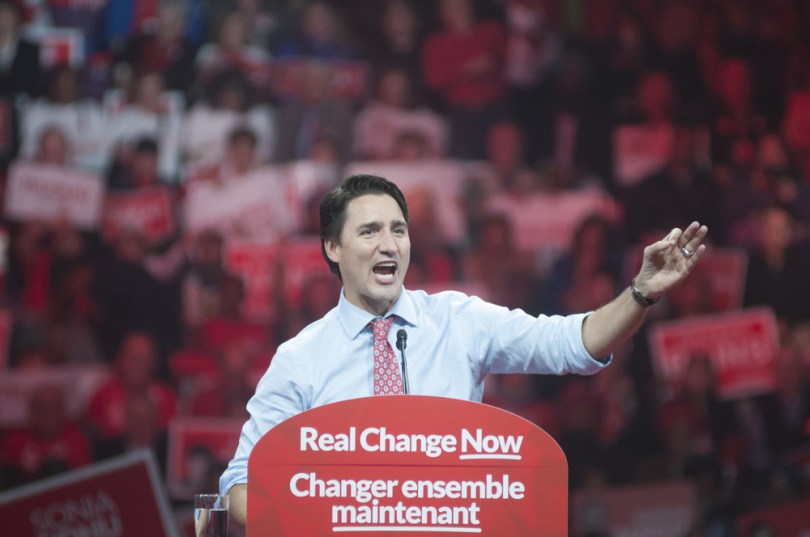
The likely impact of Trudeau’s cash-for-access reforms

By Christopher Cotton, Queen’s University

Justin Trudeau’s government is set to introduce changes to the rules governing political fundraising activities. The prime minister has faced heat for the so-called “cash-for-access” fundraisers it has held featuring the prime minister and cabinet ministers. A news report suggested the new legislation will require fundraising events to take place at public locations, rather than private homes or clubs; be announced ahead of time and summarized in reports following the events; and be open to the media. Democratic Institutions Minister Karina Gould has said any changes will revolve around making the fundraisers more transparent.

So, what is the likely impact of these reforms, what do they accomplish, and what else could be done?

Read the column at IRPP’s Policy Options
photo: shutterstock


On the Benefits of Government Intervention in the Vancouver Housing Market

By Andrea Craig, JDI Student Fellow, Queen’s University

Housing prices, housing affordability, and the impact of offshore money on residential real estate in Vancouver are not new topics. However, policies to address these issues are new. Beginning last August, foreign purchases of residential real estate in Metro Vancouver are subject to an additional 15 percent property transfer tax. In addition, last month, the provincial government announced repayable down-payment assistance for first-time homebuyers in B.C.

As consumers we associate higher tax rates with higher prices. In the usual case of a tax imposed on all consumers, this is correct. However, in the case of the foreign property transfer tax, prices will decrease (or appreciate less). Here is a stylized analysis showing how the foreign property transfer tax decreases housing prices.Read More »

Lack of government research funding biases policy to favor special interests

By Christopher Cotton, Queen’s University

U.S. Rep. Mick Mulvaney, Donald Trump’s pick for budget director, has attracted attention for asking, “Do we really need government funded research at all?” Although it’s not clear whether Mr. Mulvaney is against all government research funding, the question raises concerns of academics and proponents of evidence based policymaking.

Coauthor Arnaud Dellis (UQAM) and I speak to the impact of government funded research (or the lack thereof) in a research article (ungated) published in the most recent issue of the Journal of Law, Economics and Organization.Read More »

The Impact of Post-Secondary Funding on the Educational Attainment of Indigenous Students in Canada

By Maggie Jones, JDI Student Fellow, Queen’s University

In 1980, Canadian men with a bachelor’s degree earned approximately 32% more than those with a high school degree. For women, the equivalent figure was 44%.  By 2005 the university to high school wage premium had increased to about 41% for men and 51% for women (see Figure 1).  The rise in the wage premium over this time period shows just how important post-secondary education has become at an individual level.

In a recent working paper, titled Student Aid and the Distribution of Educational Attainment, I examine the effects of providing post-secondary funding on educational choices in the context of a large program for Indigenous students in Canada. Read More »

Fiscal Policy as a Recession Fighter: Lessons from the Interwar Period

By Gregor Smith, Queen’s University

One of the legacies of the recession and slow growth in developed economies during the past decade has been a revived consensus that discretionary fiscal policy can be used to counteract recessions, especially at times of very low interest rates. Jason Furman, chair of the US Council of Economic Advisors, outlines the theory and evidence behind this revival.

These circumstances of slow growth and low interest rates remind one of the Great Depression, so it’s natural to ask what lessons for fiscal policy the interwar period holds. Unfortunately, a disadvantage of studying that time period is that the data are sparse. National accounts data are incomplete and are available only at an annual frequency. That makes it very difficult to isolate the “shocks” (unexpected changes in fiscal policy) that are used in modern statistical studies to measure the multiplier for government spending. But there is also an advantage of studying this time period: There is a rich diversity of international experiences both in the severity of depressions and in the stance of fiscal policy. That diversity should help isolate whether fiscal policy helped recovery or not.Read More »

Developing a theory of decision making in the face of unknown unknowns

By Marie-Louise Viero, Queen’s University

“There are known knowns: There are things we know we know. We also know there are known unknowns. That is to say, we know there are some things we do not know. But there are also unknown unknowns. The ones we don’t know we don’t know.”

–Donald Rumsfeld, former U.S. Secretary of Defense

Until recently, economic analysis has only been able to deal with known knowns and known unknowns. According to the way uncertainty has been modeled, economic agents (e.g. consumers, managers, investors, etc.) start out with a detailed understanding of all things that can possibly happen. When the agent receives new information, it narrows down that list of possibilities, so that the agent’s knowledge becomes more precise over time. But, the set of possibilities never changes. Economic agents never discover new possibilities that they didn’t recognize before. There are no “unknown unknowns.”Read More »

An open letter to Stephen Poloz on interest rates

By Thorsten Koeppl, Queen’s University

In an open letter to Stephen Poloz, Thor Koeppl compares Canada’s interest rate policy to a kiwi–a cute flightless bird. 

This week, the Bank of Canada left interest rates unchanged.  Business as usual one might think.  But far from it.  In your remarks to the Standing Senate Committee on Banking, Trade and Commerce, you all but made the argument for a possible future cut in interest rates.  Your reasoning, however, seems to reflect a brave new world in central banking where interest rates have to do all the heavy lifting and may even never rise again; in other words, a world in which doves become kiwis, a cute flightless bird.

The main reasoning for a cut in interest rates would be the dire state of Canadian exports – especially from the manufacturing and resource sector.  Growth has remained anemic due to what the Bank admits is a competitiveness challenge.  Uncertainty regarding future growth in the US and emerging economies have caused businesses to not make up for lost export capacity and to engage in productivity enhancing investment.

continue reading at the C.D. Howe Institute blog

Why economic stimulus should be directed to cash strapped consumers

Queen’s PhD candidate and JDI Student Fellow, Jenny Watt, discusses recent research from the November 4, 2016 Economic History conference at Queen’s. 

By Jenny Watt, JDI Student Fellow, Queen’s University

Josh Hausman of the University of Michigan presented a paper on the role that farmers played in the recovery from the Great Depression. The paper argues that an effect called “the farm channel” explains 25% to 50% of the economic recovery occurring in America in the spring of 1933.Read More »

On the benefits of capital controls in developing economies

By Adugna Olani, Queen’s University PhD student

Government capital controls are typically viewed with skepticism because they impede capital movement across countries. Recently, the financial crisis has brought crisis transmission through capital flows to the forefront.

In recent research, I show how imposing capital controls on a short term, volatile, and potentially speculative capital flows to developing countries can improve the wellbeing of residents in those countries.Read More »