Crises Push Kids Into Classrooms, But Not Into Learning

By Christopher S. Cotton & Ardyn Nordstrom

Over recent decades, global education has made significant strides. More children than ever are attending school. But how resilient are these gains during economic downturns or environmental crises?

Our recent study explored how a severe drought in rural Zimbabwe impacted education outcomes. We found that the agricultural and economic shock increased school attendance and progression, standard measures that are typically correlated with increased learning. From these results alone, we may have concluded that droughts encourage kids to attend more school, thereby increasing their education outcomes.

However, we had access to a detailed data set on test scores from the region, the analysis of which told a different story. Even as children attended school at higher rates, their performance and learning progress decreased. Crises drove kids to school, but did not increase learning.

Our findings highlight a broader challenge: the correlation between more schooling and more learning can break down during crises. Higher attendance and enrollment rates alone should not be viewed as indicators that children have better education outcomes during such times. Studies that rely on the quantity of education to assess impact may come to the wrong conclusions. This disconnect calls for rethinking how we measure education success during challenging times.

Read More »

Can Paying Peer Reviewers Fix the Referee Shortage in Medical Research?

By Christopher Cotton, Abid Alam, and David Maslove, Queen’s University

Peer review is central to scientific publishing. Whether in economics, science, or medicine, peer review ensures research is carefully checked before reaching practitioners, policymakers, and the public. Yet, the system, which relies on experts volunteering their time, often struggles to secure enough qualified reviewers. As submissions increase and experts’ time becomes increasingly stretched, journals face delays, rushed or lower-quality reviews, and inconsistencies in evaluation.

Medicine experienced heightened challenges during the COVID-19 pandemic, as high submission volumes and limited expert availability put unprecedented strain on the system. Many researchers turned to pre-prints (papers published online without formal peer review) to speed dissemination, a practice historically less common in medical publishing.

Could paying peer reviewers help alleviate the reviewer shortage? We tested this question experimentally at Critical Care Medicine, a leading medical journal (see also the coverage of our work at Nature). Our study found modest improvements, suggesting that payment alone is insufficient to fully address the peer-review bottleneck.

Read More »

Childhood Exposure to Mass Incarceration Affects Educational Attainment

By Brock Mutic, Queen’s Economics Department

New research by Queen’s professor Sitian Liu studies the effects that exposure to mass incarceration has on the educational attainment of African Americans in a paper with relevance for policy makers hoping to understand the unintended effects of the criminal justice system in the United States.

In the United States, the educational attainment of black people has historically lagged behind that of white people. Between the 1960s and the mid-1980s, the gap began to close. Since the late-1980s, however, the gap has begun to widen again, with black men experiencing a greater decline in relative educational attainment than black women: 

Read More »

Monetary policy and the term structure of inflation expectations

By James McNeil, Queen’s University

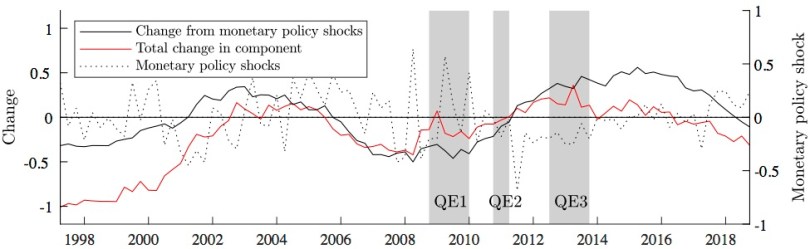
The nominal interest rate can be decomposed into the sum of the real interest rate and expected inflation through an economic relationship called the Fisher equation. While monetary policy typically works by adjusting short-run nominal interest rates, economic theory suggests that it is the real interest rate that influences borrowing and lending decisions. How much of an adjustment to the nominal interest rate passes through to affect the real interest rate – and hence the real economy – will depend on the response of inflation expectations.

Furthermore, central banks may wish to directly influence inflation expectations to avoid falling into a liquidity trap or to achieve additional stimulus when nominal interest rates are exceptionally low. In 2009 the Federal Reserve lowered its policy interest rate to zero, which is considered to be the lower limit, effectively losing its main policy tool. In response, it turned to unconventional monetary policy operations such as forward guidance (promising to keep interest rates low for an extended period of time) and large-scale asset purchase programs (often referred to as Quantitative Easing). If these unconventional policies are able to directly move inflation expectations when short-run nominal interest rates are constrained then the Federal Reserve would have the means to affect real interest rates when its preferred policy tool is not available.Read More »

Workshop on the Economics of Strategic Communication and Persuasion: Application to Evidence-based Public Policy

By Eric Richert, Queen’s University

On November 16-17th the second workshop on the economics of strategic communication and persuasion was hosted by CIRANO, CIREQ, the John Deutsch Institute and the Dean of Arts Development Fund at CIRANO in Montreal. The keynote speaker was Joel Sobel who presented on “Sequential versus simultaneous disclosure”. Six other papers were presented in this workshop.Read More »

What can the human genome project teach us about intellectual property policy?

By Kyla Fisher, M.A. Economics, Queen’s University

Innovation is one of the primary drivers of economic growth and improvements in living standards. It often produces larger social benefits than private benefits, leading firms to under-invest in R&D compared to the socially-optimal level. One of the ways that the government works to overcome this gap is through offering intellectual property (IP) protections, giving firms a temporary monopoly on commercializing their ideas. In addition, many governments allocate significant funds directly towards research through public research institutions or universities. However, it is difficult to determine the impact of these public efforts to stimulate innovation as we are unable to know the counterfactual. This article reviews the findings from an innovative study by Heidi Williams (2013) on the use of IP during the sequencing of the human genome. The study exploits the discrete nature of gene sequencing and the fact that it was researched both publicly and privately to evaluate the impact of IP on innovation outcomes. Despite the importance of IP policy for technological innovation there are relatively few empirical studies in this area. For this reason, Williams’ study generated quite a bit of interest at the time of publication and has been cited in multiple U.S. Supreme Court briefings.

Read More »

Queen’s Organizational Economics Conference

By Saad Khan, Queen’s University

On Thursday, June 14th, 2018, the Smith School of Business at Queen’s University hosted the Organizational Economics Conference. The conference covered a broad range of topics of particular interest to policy decisions related to the organization of businesses. The topics were as follows:  [1] growth prospects of franchises versus independent businesses, [2] the performance of serial entrepreneurs, [3] the effect of acquisitions designed to preempt competition on the continuation of the acquired project, [4] the effect of middle management treatment of employees on worker turnover and productivity, and [5] the optimal design of wage contract. This article summarizes the main findings of three papers presented at the conference and comments on policy implications.

Read More »

Worker Mobility, Inequality, and Credit Scoring: Insights from the Macroeconomic Frontier

By Blair Long, Queen’s University

On Tuesday, May 11, the Queen’s Economics Department (QED) hosted the 12th Frontiers of Macroeconomics workshop (hereafter Frontiers). This conference brings together a diverse collection of contemporary research, exemplifying the frontier of modern macroeconomics. This article summarizes the objectives and findings of some of the conference’s presented work, and provides some commentary on the direction of both theory and methodology in macroeconomics.

What are the Determinants of Worker Job Matches?  

Ilse Lindenlaub’s “Multi-Dimensional Sorting of Workers and Jobs in the Data” (with Fabien Postel-Vinay) explores the mobility of workers and asks which worker skills are relevant in the sorting process. By sorting, economists mean how workers move from job to job, each time finding a “better” match, and ultimately finding one that is stable, in the sense that neither the worker nor the job (the firm) expects to prefer another working arrangement. The key methodological contribution is to develop a relatively simple test of how skills drive sorting behaviour, accounting for the considerable heterogeneity of skills. In doing so, the authors break from a standard simplification found in much economic theory: that worker ability (for instance) is one-dimensional. Of course, in the real world, we can group workers according to a near-infinity of skills, such as interpersonal, cognitive, non-cognitive, routine, manual, or creative. Read More »

Statistics Canada Crowdsources Cannabis Prices

By Allan W. Gregory and Eliane Hamel Barker, Queen’s University

Statistics Canada recently took up the difficult challenge of finding out what Canadians pay for their cannabis both medically (licensed and unlicensed) and recreationally. Currently only licensed use of medical cannabis (both dried and oil) is legal to purchase from licensed producers under Access to Cannabis for Medical Purposes Regulations (ACMPR). One reason governments are so interested in the street price of cannabis is the legalization of marijuana for recreational use due sometime this summer. The thinking is that legal marijuana prices must not be greater than those on the street; otherwise black markets will continue to flourish.

Statistics Canada is not new to the survey business and have in the past attempted to price cannabis and quantities smoked. However, in their most recent effort, a novel feature was using crowdsourcing on a web site survey to gather the data. Statistics Canada understood that there was a selectivity or participation problem in such a methodology but decided this was the best approach possible. We agree with this decision. Since cannabis was soon to be legalized for recreational use and no special personal identifiers were asked, the participating decision should not be associated with either positive (higher price) or negative (lower price) bias.Read More »

What can we Learn from Historical Economic and Financial Crises?

These notes form a short extract from the forthcoming monograph by John Crean and Frank Milne, The Anatomy of Systemic Risk, (2017a); and a shorter working paper, The Foundations of Systemic Risk (2017b).

By Frank Milne, Queen’s University

There are many historical financial crises that resemble the recent crisis of 2007-9. Crean and Milne provide a summary of various banking crises, discuss their similarities, provide a theory integrating their observations and examine the implications for Risk Management systems and financial regulation.

Here we will restrict our discussion to two major banking crises that should be of interest for Canadians. There are clear parallels with current Canadian banking and regulatory risks. We will draw some conclusions that are supported by the Crean-Milne framework.

The first example is the Australian Banking Crisis of the 1890s, and the second example is the Texas Banking Crisis of 1980-89.Read More »